jQuantStats: Portfolio Analytics for Quants









Overview
jQuantStats is a Python library for portfolio analytics that helps quants and portfolio managers understand their strategy performance in depth. It provides two complementary entry points: a Portfolio route that works directly from price and position data, and a Data route for arbitrary return streams. All analytics, visualizations, and HTML reports are available from either entry point.
The library is inspired by QuantStats, but extends it significantly — particularly around position-level analysis that is impossible when you start from a return series alone. Key improvements include:
- Polars-native design with zero pandas runtime dependency
- Modern interactive visualizations using Plotly, or static ones using matplotlib
- A Portfolio route — the primary entry point — that exposes tools unavailable in QuantStats
- Comprehensive test coverage with pytest
- Clean, fully type-annotated API
The Portfolio Route — Why It Matters
The original QuantStats only accepts a return series. That is convenient but lossy: once you reduce prices and positions to returns, you lose the information needed to answer the questions that matter most in practice.
jQuantStats introduces Portfolio as the primary entry point. You provide the raw
price series and the cash positions your strategy held over time, and the library compiles
the NAV for you. This unlocks a class of analysis tools that simply do not exist in
QuantStats:
Execution-Delay Analysis
Real strategies suffer from execution lag: the signal fires at the close, but the trade
fills the next open, or the next close, or later. A return series hides this completely.
A Portfolio exposes it.
>>> import numpy as np
>>> import polars as pl
>>> from jquantstats import Portfolio

>>> rng = np.random.default_rng(42)
>>> n = 252  # approximately one trading year

>>> prices = pl.DataFrame(
...     {
...         "date": pl.date_range(pl.date(2020, 1, 2), pl.date(2020, 12, 31), interval="1d", eager=True)[:n],
...         "AAPL": (100.0 * np.cumprod(1 + rng.normal(0.0005, 0.015, n))).tolist(),
...         "META": (150.0 * np.cumprod(1 + rng.normal(0.0003, 0.018, n))).tolist(),
...     }
... )

>>> # Allocate $500k to each asset as constant cash positions
>>> positions = prices.select("date").with_columns(
...     [
...         pl.lit(500_000.0).alias("AAPL"),
...         pl.lit(500_000.0).alias("META"),
...     ]
... )

>>> pf = Portfolio.from_cash_position(prices=prices, cash_position=positions, aum=1_000_000)

>>> # Shift all positions forward by one period — simulate T+1 execution
>>> pf_lagged = pf.lag(1)

>>> sharpe_t0 = pf.stats.sharpe()  # ideal (no delay)
>>> sharpe_t1 = pf_lagged.stats.sharpe()  # realistic (T+1 fill)
lag(n) returns a new Portfolio with positions shifted by n periods.
Because every downstream accessor — .stats, .plots, .report — recomputes
on the shifted positions, a single call gives you the full analytics picture
under a different execution assumption.
lead_lag_ir_plot() sweeps the entire range at once and renders it as an
interactive Plotly bar chart:
>>> fig = pf.plots.lead_lag_ir_plot(start=-5, end=10)
>>> # fig.show()  — Sharpe ratio at each lag, from lead-5 to lag+10
This chart immediately answers: how much does a one-day execution delay cost in Sharpe? At what lag does the signal degrade to noise?
Tilt / Timing Attribution
Even without lag analysis, starting from positions lets you decompose performance into two orthogonal sources:
- Tilt — the portfolio with constant average weights (pure allocation skill)
- Timing — the deviation from average weights (pure timing skill)
>>> tilt_pf = pf.tilt  # constant-weight version of the strategy
>>> timing_pf = pf.timing  # weight deviations only

>>> tilt_sharpe = tilt_pf.stats.sharpe()
>>> timing_sharpe = timing_pf.stats.sharpe()

>>> decomp = pf.tilt_timing_decomp  # DataFrame: portfolio | tilt | timing NAVs side by side
Turnover Analytics
>>> turnover = pf.turnover  # daily one-way turnover as fraction of AUM
>>> turnover_weekly = pf.turnover_weekly  # weekly aggregate (or 5-period rolling sum)
>>> turnover_summary = pf.turnover_summary()  # mean_daily, mean_weekly, turnover_std
Cost Modeling
Two independent cost models, never accidentally combined:
>>> from jquantstats import Portfolio, CostModel

>>> # Model A: per-unit cost (equity, futures tick-size costs)
>>> pf_net = Portfolio.from_cash_position(
...     prices=prices,
...     cash_position=positions,
...     aum=1_000_000,
...     cost_model=CostModel.per_unit(0.01),
... )
>>> net_cost_nav = pf_net.net_cost_nav  # NAV path after deducting position-delta costs

>>> # Model B: turnover-bps cost (macro, fund-of-funds)
>>> pf_bps = Portfolio.from_cash_position(
...     prices=prices,
...     cash_position=positions,
...     aum=1_000_000,
...     cost_model=CostModel.turnover_bps(5.0),
... )
>>> # Sweep Sharpe across 0 → 20 bps in a single call
>>> impact = pf_bps.trading_cost_impact(max_bps=20)
Position Variants
>>> # From unit positions (quantity × price → cash automatically)
>>> units = prices.select("date").with_columns(
...     [
...         pl.lit(1_000.0).alias("AAPL"),
...         pl.lit(500.0).alias("META"),
...     ]
... )
>>> pf = Portfolio.from_position(prices=prices, position=units, aum=1_000_000)

>>> # From risk positions (de-volatized via EWMA, optional vol cap)
>>> risk_units = units
>>> pf = Portfolio.from_risk_position(
...     prices=prices,
...     risk_position=risk_units,
...     aum=1_000_000,
...     vol_cap=0.20,
... )

>>> # Smooth noisy positions with a rolling mean
>>> pf_smooth = pf.smoothed_holding(n=5)
jQuantStats vs QuantStats
| Feature | jQuantStats | QuantStats |
|---|---|---|
| DataFrame engine | Polars (zero pandas at runtime) | pandas |
| Visualisation | Plotly or matplotlib, both rendered natively | matplotlib / seaborn, with a to_plotly() converter |
| Input format | polars.DataFrame |
pandas.Series / pandas.DataFrame |
| Entry point — positions | Portfolio.from_cash_position(prices, cash_position, aum) |
— |
| Entry point — returns | Data.from_returns(returns, benchmark) |
qs.reports.full(returns) |
| Execution-delay analysis | pf.lag(n) + pf.plots.lead_lag_ir_plot() |
— |
| Tilt / timing decomposition | pf.tilt, pf.timing, pf.tilt_timing_decomp |
— |
| Turnover analytics | pf.turnover, pf.turnover_summary() |
— |
| Cost models | Two models: per-unit and turnover-bps | — |
| Cost-impact sweep | pf.trading_cost_impact(max_bps=20) |
— |
| HTML report | pf.report.to_html() |
qs.reports.html(returns) |
| Snapshot chart | pf.plots.snapshot() |
qs.plots.snapshot(returns) |
| Sharpe ratio | pf.stats.sharpe() |
qs.stats.sharpe(returns) |
| Max drawdown | pf.stats.max_drawdown() |
qs.stats.max_drawdown(returns) |
| Python version | 3.11+ | 3.7+ |
| Type annotations | Full (py.typed) |
Partial |
| Test coverage | pytest + coverage | — |
Dashboard Preview
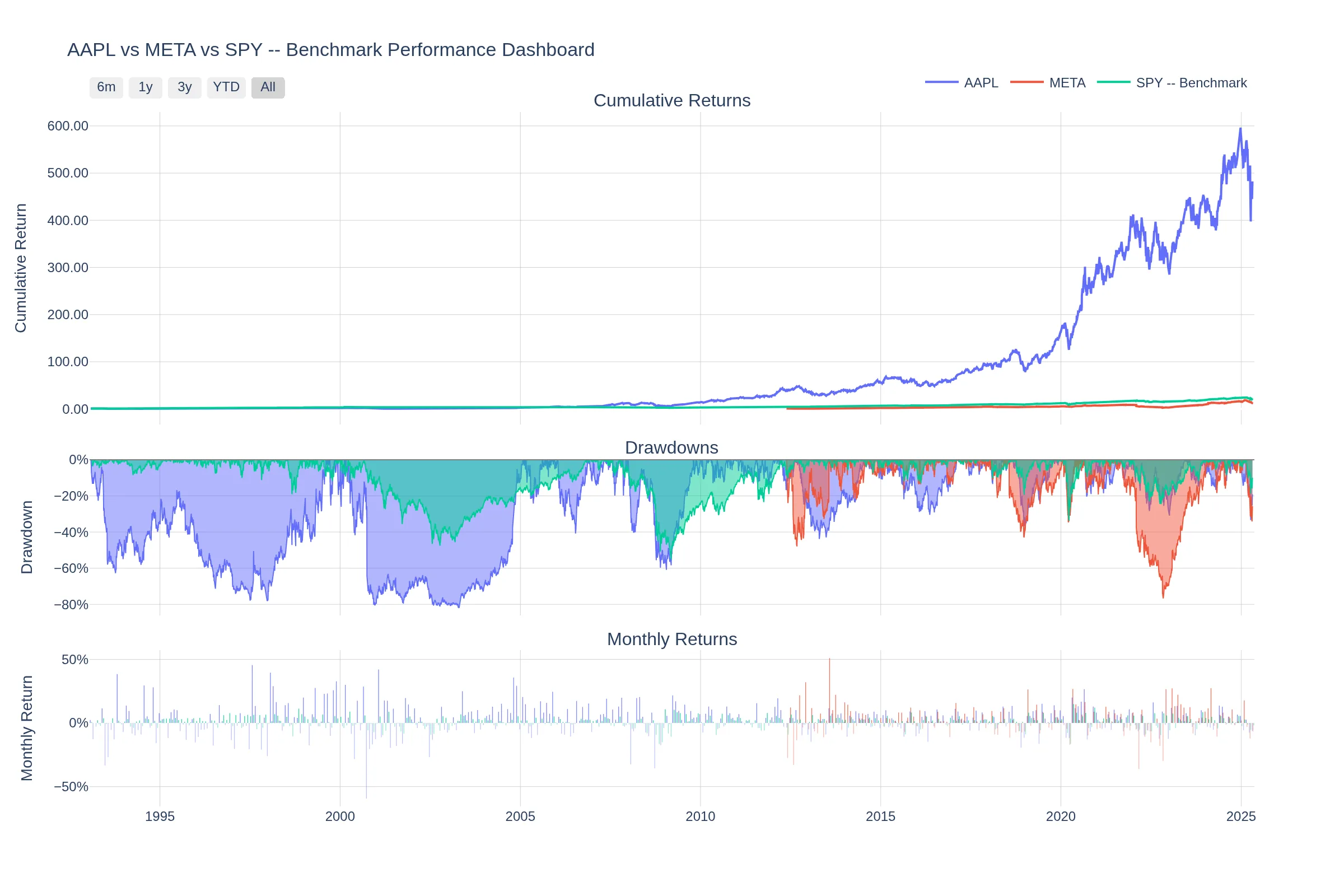
Interactive Plotly dashboard — cumulative returns, drawdowns, and monthly return heatmaps in a single view. Charts are fully interactive (zoom, pan, hover tooltips) when rendered in a browser.
Every chart the library draws, each labelled with the single call that produced
it, is in the Chart Gallery.
Regenerate the images with uv run --with pillow python book/shots/generate.py.
Installation
Using pip:
Using conda (via conda-forge):
For development:
Quick Start
Start from prices and positions (recommended)
>>> import polars as pl
>>> from jquantstats import Portfolio

>>> prices = pl.DataFrame(
...     {
...         "date": ["2023-01-01", "2023-01-02", "2023-01-03"],
...         "AAPL": [150.0, 152.0, 149.5],
...         "MSFT": [250.0, 253.0, 251.0],
...     }
... ).with_columns(pl.col("date").str.to_date())

>>> positions = pl.DataFrame(
...     {
...         "date": ["2023-01-01", "2023-01-02", "2023-01-03"],
...         "AAPL": [500.0, 500.0, 600.0],
...         "MSFT": [300.0, 300.0, 300.0],
...     }
... ).with_columns(pl.col("date").str.to_date())

>>> pf = Portfolio.from_cash_position(prices=prices, cash_position=positions, aum=1_000_000)

>>> sharpe = pf.stats.sharpe()
>>> fig = pf.plots.snapshot()  # call fig.show() to display
Compare ideal vs. delayed execution
>>> pf_t0 = pf  # signal executed immediately
>>> pf_t1 = pf.lag(1)  # T+1 execution
>>> pf_t2 = pf.lag(2)  # T+2 execution

>>> sharpe_t0 = pf_t0.stats.sharpe()
>>> sharpe_t1 = pf_t1.stats.sharpe()
>>> sharpe_t2 = pf_t2.stats.sharpe()

>>> # Or visualize the full lead/lag Sharpe profile in one chart
>>> fig = pf.plots.lead_lag_ir_plot(start=-5, end=10)
>>> # fig.show()
Start from a return series
>>> import polars as pl
>>> from jquantstats import Data

>>> returns = pl.DataFrame(
...     {
...         "Date": ["2023-01-01", "2023-01-02", "2023-01-03", "2023-01-04", "2023-01-05"],
...         "Strategy": [0.01, -0.03, 0.02, -0.01, 0.04],
...     }
... ).with_columns(pl.col("Date").str.to_date())

>>> benchmark = pl.DataFrame(
...     {
...         "Date": ["2023-01-01", "2023-01-02", "2023-01-03", "2023-01-04", "2023-01-05"],
...         "Benchmark": [0.005, -0.01, 0.008, -0.005, 0.015],
...     }
... ).with_columns(pl.col("Date").str.to_date())

>>> data = Data.from_returns(returns=returns, benchmark=benchmark)

>>> sharpe = data.stats.sharpe()  # {'Strategy': 4.24, 'Benchmark': 4.94}
>>> max_dd = data.stats.max_drawdown()  # {'Strategy': 0.03, 'Benchmark': 0.01}
>>> fig = data.plots.snapshot(title="Strategy vs Benchmark")  # call fig.show() to display
Risk metrics
>>> sharpe = data.stats.sharpe()
>>> sortino = data.stats.sortino()
>>> max_dd = data.stats.max_drawdown()
>>> vol = data.stats.volatility()
>>> var = data.stats.value_at_risk()
>>> cvar = data.stats.conditional_value_at_risk()
>>> calmar = data.stats.calmar()
>>> win = data.stats.win_rate()
Benchmark comparison
>>> ir = data.stats.information_ratio()
>>> greeks = data.stats.greeks()
>>> alpha = greeks["Strategy"]["alpha"]
>>> beta = greeks["Strategy"]["beta"]
Generate a full HTML report
>>> pf = Portfolio.from_cash_position(prices=prices, cash_position=positions, aum=1_000_000)

>>> path = pf.report.to_html(path="output/report.html")  # parent dirs are created for you
>>> path.as_posix()
'output/report.html'
Hosted report API
The [web] extra ships a small FastAPI service (api/app.py) that turns
uploaded prices and positions CSVs into the full HTML report:
Hardening is built in (upload size/row/column limits, sliding-window rate limiting, deny-by-default CORS) and configured via environment variables:
| Variable | Effect | Default |
|---|---|---|
JQS_API_KEY |
require this value in the X-API-Key header |
unset (auth off) |
JQS_CORS_ORIGINS |
comma-separated allowed origins | deny all cross-origin |
JQS_RATE_LIMIT_MAX_REQUESTS |
requests per client per window | 30 |
JQS_RATE_LIMIT_WINDOW_SECONDS |
sliding-window length in seconds | 60 |
With auth enabled, clients pass the key as a header:
export JQS_API_KEY="change-me"
curl -H "X-API-Key: change-me" \
  -F "prices=@prices.csv" -F "positions=@positions.csv" -F "aum=1000000" \
  http://localhost:8000/report
The built-in rate limiter is per-process; if you scale beyond one instance, put a shared limiter in front — see the deployment FAQ for a reverse-proxy recipe.
Features
Performance Metrics — Sharpe, Sortino, Calmar, Omega, Treynor, Information Ratio, probabilistic Sharpe/Sortino, smart Sharpe/Sortino, CAGR, GHPR, and more.
Risk Analysis — Value at Risk (VaR), Conditional VaR, drawdown details, max drawdown duration, Ulcer Index, Ulcer Performance Index, risk of ruin.
Win/Loss Statistics — win rate, monthly win rate, profit factor, payoff ratio, consecutive wins/losses, tail ratio, gain-to-pain ratio, outlier win/loss ratios.
Benchmark Analysis — alpha, beta, correlation, tracking error, information ratio, up/down capture ratios, R².
Rolling Analytics — rolling Sharpe, Sortino, volatility, and Greeks with configurable windows.
Portfolio-native (not available in QuantStats):
- Execution-delay analysis via lag(n) and lead_lag_ir_plot()
- Tilt / timing attribution via tilt, timing, tilt_timing_decomp
- Turnover analytics via turnover, turnover_weekly, turnover_summary()
- Cost modeling via CostModel.per_unit() / CostModel.turnover_bps()
- Cost-impact sweep via trading_cost_impact(max_bps)
- Position smoothing via smoothed_holding(n)
- Risk-position entry via from_risk_position() with EWMA de-volatization
Visualizations, two ways — every chart renders as an interactive Plotly figure
(zoom, pan, hover tooltips, range selectors) or, with pip install jquantstats[mpl]
and set_plot_backend("matplotlib"), as a static matplotlib one. Both draw from the
same numbers. Includes portfolio snapshot, lead/lag IR, correlation heatmap,
drawdown, rolling returns, rolling volatility, return distribution, monthly heatmap.
HTML Reports — self-contained reports with embedded interactive charts and categorized metric tables, rendered via Jinja2 templates.
Requirements
- Python 3.11+
- numpy
- polars
- plotly
- scipy
Optional extras: mpl (matplotlib rendering backend), plot (static image
export via kaleido), web (FastAPI service).
Documentation
For detailed documentation, visit jQuantStats Documentation.
The public API (Portfolio and Data) follows Semantic Versioning
from v1.0.0 onwards; see the
API Stability & deprecation policy
for the exact stability guarantee and deprecation timeline.
Contributing
Contributions are welcome! Please feel free to submit a Pull Request.
- Fork the repository
- Create your feature branch (
git checkout -b feature/amazing-feature) - Commit your changes (
git commit -m 'Add some amazing feature') - Push to the branch (
git push origin feature/amazing-feature) - Open a Pull Request
Citing
If you use jQuantStats in academic work or research reports, please cite it using:
@software{jquantstats,
  author    = {Schmelzer, Thomas},
  title     = {jQuantStats: Portfolio Analytics for Quants},
  url       = {https://github.com/jebel-quant/jquantstats},
  version   = {0.9.0},
  year      = {2026},
  license   = {MIT}
}
License
This project is licensed under the MIT License - see the LICENSE file for details.